
Construction sustainability is often reduced to a shopping list: low-carbon concrete, recycled steel, timber instead of concrete. Those choices matter, but the more consequential shift is that owners, designers and contractors are being asked to account for the emissions and resource use of materials before a building opens, not just the energy it consumes afterward.
That changes the questions asked at the drawing board. Can the existing structure be retained? Can the design use less material? If a new product is specified, is its environmental claim comparable with the alternatives, and will it perform for the building’s intended life?
Table of Contents
- Why materials are in the climate spotlight
- The first sustainable material may be the one you do not buy
- How concrete, steel and timber are changing
- From demolition waste to a material supply
- How to specify materials without greenwashing
- Frequently asked questions
Why materials are in the climate spotlight
Buildings and construction are responsible for around 37% of global CO₂ emissions and nearly half of global material extraction, according to the United Nations Environment Programme’s Global Status Report for Buildings and Construction 2025–2026, published in May 2026. The report says global building floor area reached 273 billion square metres in 2024 and grew by 1.7% that year. Even efficient buildings therefore create a substantial demand for cement, metals, glass, timber and other resources.
That is why sustainability goals are expanding from operational energy, such as heating and cooling, to embodied carbon: emissions associated with extracting raw materials, manufacturing products, transporting them, constructing the building, maintaining it and dealing with it at end of life. The precise result depends on the assessment boundary and assumptions, so a product’s carbon number is useful only when its scope and declared performance can be compared fairly.
My view is that material selection should not start with “Which product is greenest?” It should start with “What is the least resource-intensive way to deliver the required building?” That distinction can change the project more than swapping one branded product for another.
The first sustainable material may be the one you do not buy
Keeping a sound building in use can avoid new structural materials altogether. Where replacement is necessary, efficient spans, regular grids, careful structural coordination and right-sized specifications can reduce demand without compromising safety or function. Reuse and material efficiency are not glamorous product categories, but they address impacts before they are locked into a design.
Construction teams can put that hierarchy into practice by:
- Assessing whether an existing building or structure can be renovated, adapted or extended.
- Reducing overdesign through early coordination between architecture, structure and building services.
- Prioritizing durable assemblies that can be repaired rather than replaced wholesale.
- Designing connections and layers so components can be separated and recovered later.
- Checking product-specific environmental declarations against equivalent products with the same function.
There is a real counterargument: renovating is not always the lower-impact or more affordable option. A building may be unsafe, poorly located, difficult to adapt, or so inefficient that substantial work is needed. The answer is not to preserve every structure regardless of cost; it is to compare credible renovation and new-build scenarios using the same functional needs, study period and life-cycle boundaries.
How concrete, steel and timber are changing
Concrete and steel remain hard to replace in many applications because they provide strength, fire resistance, durability and established construction systems. Sustainability goals are therefore pushing both material innovation and more disciplined use: lower-emissions production, recycled content where technically suitable, and designs that use less material in the first place.

In concrete, the cement binder is a key focus because its manufacture is emissions-intensive. Options include blended binders and supplementary cementitious materials, alongside optimized structural design. Recycled concrete aggregate can reduce demand for virgin aggregate, but it does not automatically make a concrete mix low-carbon: binder content, processing, transport and durability all affect the result. The Federal Highway Administration notes that recycled aggregate can have higher water absorption and can affect workability; testing and mix adjustment are important for the intended application.
Steelmakers are reducing impacts through greater scrap use and lower-emissions production routes, while project teams can reduce tonnage through efficient structural design and retain steel components for reuse. The relevant comparison is not a material label in isolation. It is the quantity needed to meet the same structural, safety and service-life requirements, supported by product-specific data where available.
Timber can store biogenic carbon in the product and may replace some more emissions-intensive structural materials, but the result is not universal. Forest management, sourcing, manufacturing energy, transport, fire protection, service life and end-of-life treatment all matter. A U.S. Forest Service life-cycle assessment comparing code-compliant multi-storey mass-timber, steel and concrete buildings found favorable results for timber across many assessed impacts in the modeled cases, while also identifying regional supply and other building components as relevant factors. That is evidence for evaluating timber as an option, not a guarantee that every timber project is lower-impact.
| Material strategy | Potential sustainability contribution | What to verify before specifying |
|---|---|---|
| Lower-carbon concrete | Can reduce emissions tied to the binder while preserving concrete’s structural role. | Binder composition, mix performance, curing needs, local availability and declared life-cycle boundary. |
| Recycled concrete aggregate | Can divert suitable demolition concrete and reduce demand for virgin aggregate. | Source quality, contaminants, absorption, mix workability, strength and durability testing. |
| Recycled or lower-emissions steel | Can reduce reliance on virgin inputs or emissions-intensive production routes. | Verified product-specific data, recycled content definition, structural grade and supply logistics. |
| Certified or responsibly sourced timber | Can substitute for other structural materials and store carbon during the product’s service life. | Forest sourcing, durability, fire and moisture design, transport and end-of-life assumptions. |
| Reclaimed components | Can preserve the value of products already manufactured and avoid some new production. | Condition, dimensions, hazardous substances, testing, code acceptance and reliable supply. |
Comparison note: These are design considerations, not universal carbon rankings. UNEP’s 2025–2026 sector report and the Federal Highway Administration’s recycled-aggregate guidance describe why whole-life impacts and technical suitability must be considered together; project teams should use comparable, product-specific assessments for decisions.
From demolition waste to a material supply
Reuse is more demanding than putting a recycling symbol in a specification. A component needs to be identified, separated without damaging it, checked for hazards and performance, stored, transported and accepted by the next project. Those steps require coordination before demolition, not after a mixed pile of debris has been produced.
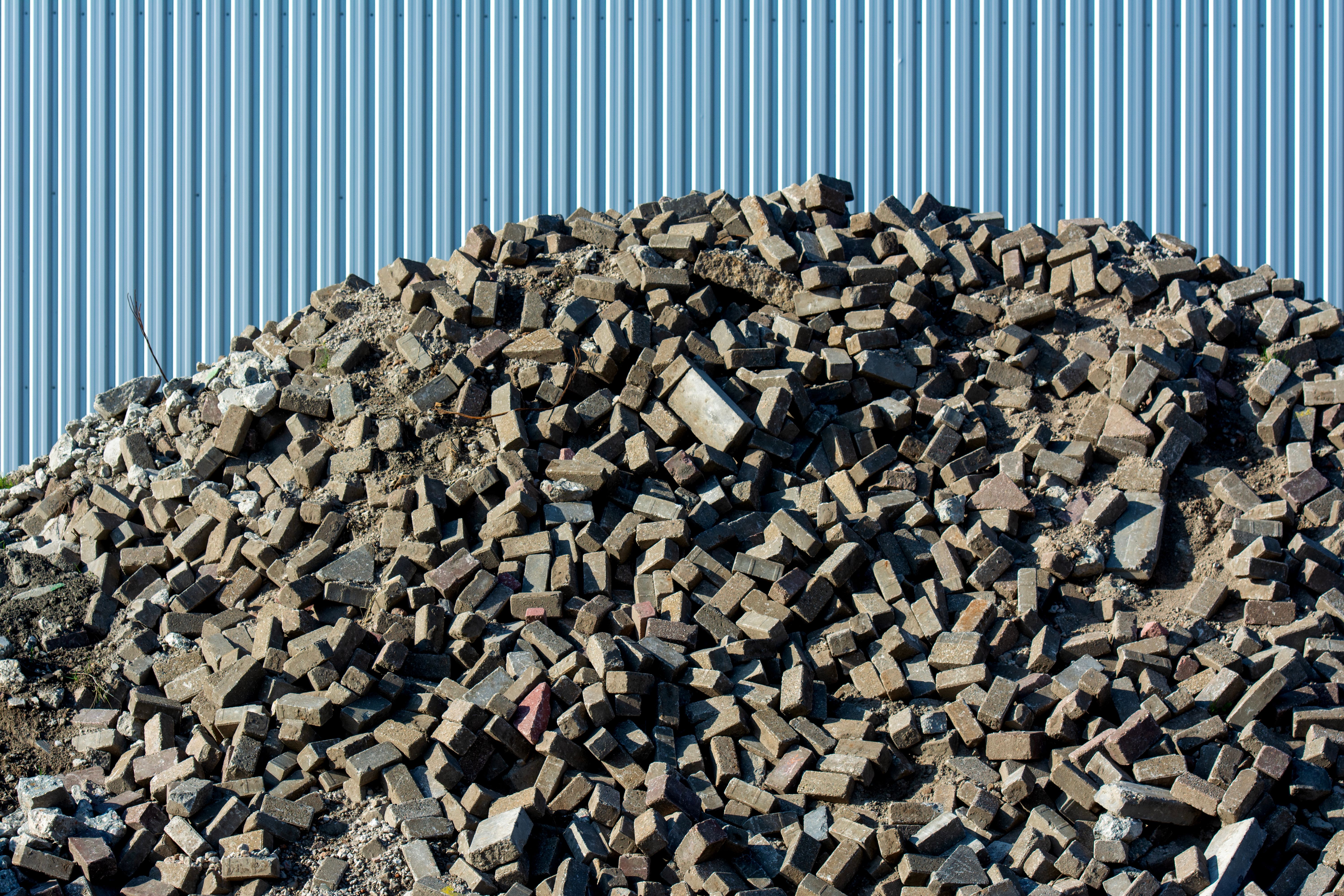
The European Commission says construction and demolition waste makes up more than a third of waste generated in the EU, while recovery rates vary widely between countries. Its 2024 Construction and Demolition Waste Management Protocol emphasizes pre-demolition audits, selective demolition, source separation and quality assurance. The practical lesson travels beyond Europe: reuse depends on predictable quality and traceability as much as on good intentions.
Reuse can also be visible in the finished site. For example, when choosing exterior boundaries, designers can consider service life, repairability, material recovery and local sourcing alongside appearance; these criteria apply to elements such as fencing as well as larger building components.
How to specify materials without greenwashing
A sustainability target is useful when it changes a measurable project decision. For material procurement, the strongest process makes the target explicit early, defines the assessment method and requires evidence that can be compared consistently.
- Set the boundary. Decide whether the target covers product manufacture, transport, construction, use, replacement and end of life.
- Compare like with like. A structural product should be compared with alternatives delivering the same function, not just by weight or a favorable isolated metric.
- Ask for an Environmental Product Declaration (EPD). Check that it applies to the actual product and product category, and note whether the data is specific to the manufacturer or based on an industry average.
- Include performance. A product that needs premature replacement can lose its apparent advantage over a longer-lived alternative.
- Check logistics and availability. A theoretical low-carbon option may not be available in the required quantity or on the project schedule.
- Track substitutions. Review changes during procurement so a product’s sustainability claim is not lost when the specified item is unavailable.
Standards and targets are useful, but they do not make judgment unnecessary. I would favor a project that first tests retention and material reduction, then uses verified lower-impact products where they perform, over one that leads with a green-material label and leaves the design unchanged. The strongest sustainability programs measure both the material avoided and the material selected.
Frequently Asked Questions
The construction sector’s material shift is not a simple race to replace concrete and steel. It is a redesign of decisions: build only what is needed, use less where engineering allows, retain what still works, and demand credible evidence for what is new. That sequence is less marketable than a miracle material, but it is a sturdier basis for meeting sustainability goals.